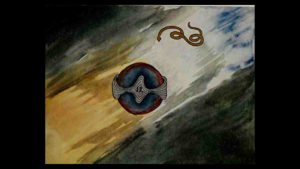
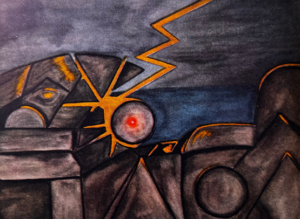
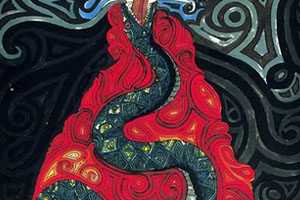
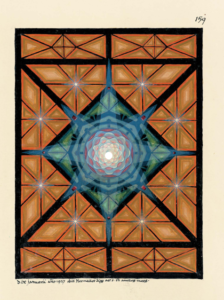
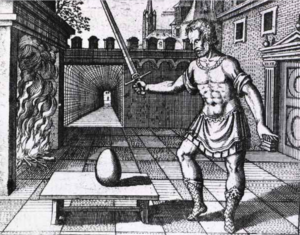
“The ‘union of irreconcilables:’ marriage of water and fire. The two figures each have four hands to symbolize their many different capabilities.”
Figure 72
from Jung: His life and Work by Barbara Hannah
Altogether, Jung’s health seemed to be particularly good in the autumn of 1946…. It was, therefore, a completely unexpected shock to hear… that he had another heart attack and was again very ill. This time, refusing to go to the hospital, he had to have two nurses to look after him, day and night, in his own house.
The illness was even more unexpected, especially to Jung himself, than the one in 1944. He had the feeling then that “there was something wrong with my attitude,” and at first felt in some way responsible for having broken his leg. But this time it was a real bolt from the blue …
Jung remained ill for three months. About December 16 he sent me a message that he was still suspended over the abyss and warning me against optimism; he added that the real trouble was in the sympathicus. After his illness he told me that he was doubtful if he really had a heart infarct. At all events, it was mainly a disturbance of the vegetative nervous system that had the effect of giving him tachycardia (racing of the pulse. He again found himself confronted, like medicine men all over the world, with curing himself. The doctors insisted it was another heart infarct; and thus he was forced to find out for himself what was really the matter and how it should be met. One again he said that he had an illness because he was faced with the mysterious problem of the hieros gamos (the mysterium coniuntionis.) As late as October 15, 1957 (eleven years after this illness), he wrote in a letter:
As some alchemists had to admit, that the never succeeded in producing the gold or the Stone. I cannot confess to have solved the riddle of the coniunctio mystery. On the contrary, I am darkly aware of things lurking in the background of the problem –things too big for horizons.
It was his effort to write about these things “too big for horizons” and to solve their riddle that brought about Jung’s further illness.
These illnesses were really the direct result of what Jung always called “the only unbearable torture of not understanding,” but since the hieros gamos is so infinitely more incomprehensible that anything he was ever faced with in his life, it required at least two actual physical illnesses and the near neighborhood of death before he could understand it enough to on with his book.
Pages 294-295

“The science of the I Ching…is based on what I have tentatively called the synchronistic principle. My occupation with the psychology of unconscious process long ago necessitated my casting around for another explanatory principle, because the causality principle seemed to me inadequate for the explanation of certain remarkable phenomena of the unconscious.
Thus I found there are psychic parallelisms which cannot be related to each other causally, but which must stand in another sort of consciousness. This connection seemed to me to lie mainly in the relative simultaneity of the events, therefore the expression ‘synchronistic’.
It seems, indeed, as though time, far from being an abstraction, is a concrete continuum which contains qualities or basic conditions manifesting themselves simultaneously in various places in a way not to be explained by causal parallelism, as, for example, in cases of the coincident appearance of identical thoughts, symbols, or psychic states.”
The Secret of the Golden Flower