Snake

Snakes in the Psyche III

by Stephen Parker, Ph.D (Article Selection and Commentary) on August 28, 2010

From the website of Maria Taveras, a Jungian analyst and artist

Jung also discusses a case in which a snake emerged from the mouth of a woman. After World War I, a 28-year-old woman consulted Jung. She wanted “to be cured within ten hours” – that is, within only ten analytic sessions. The woman told Jung that “she had a black serpent in her belly.” That was the reason the woman had consulted him, “for she thought that it should be awakened” (1996: 84). The woman was “only intuitive, entirely without a sense of reality.” Then she announced that the snake, which had been dormant, had suddenly become active. “One day she came and said that the serpent in her belly had moved; it had turned around,” Jung says. “Then the serpent moved slowly upward, coming finally out of her mouth, and she saw that the head was golden” (1996: 85).

In another account of the same case, Jung mentions “a young woman about 27 or 28″ who informed him during her initial analytic session that she had a snake in her belly: “Her first words were when I had seated her, ‘You know, doctor, I come to you because I have a snake in my abdomen.’” Jung exclaimed: “What?!” The woman replied: “‘Yes, a snake, a black snake coiled up right in the bottom of my abdomen.’” According to Jung, “I must have made a rather bewildered face at her, for she said, ‘You know, I don’t mean it literally, but I should say it was a snake, a snake.’” In the middle of her analysis, “which lasted only for ten consultations,” the woman told Jung that she had predicted how the analysis would conclude: “‘I’ll come ten times, and then it will be all right.’” How, Jung asked, did she know? “‘Oh,’” she said, “‘I’ve got a hunch.’” When the woman appeared for her fifth or sixth session, she said, ‘Oh, doctor, I must tell you, the snake has risen, it is now about here’” (1977: 309). When she appeared for her tenth session, Jung inquired: “‘Now this is our last consultation. Do you feel cured?’” (1977: 309-10). The woman said: “‘You know, this morning it came up, it came out of my mouth, and the head was golden’” (1977: 310).

Jung amplifies the image of the snake in the abdomen by reference to the serpent in Kundalini Yoga. “I told you,” Jung says, “the case of that intuitive girl who suddenly came out with the statement that she had a black snake in her belly.” He situates the snake in the context of the collective unconscious. “Well now, that is a collective symbol,” he says. “That is not an individual fantasy, it is a collective fantasy.” The image of the snake in the abdomen, Jung says, “is well known in India.” Although the woman “had nothing to do with India” and although the image “is entirely unknown to us,” he says that “we have it too, for we are all similarly human.” When the woman first told Jung about the snake in her belly, he wondered whether “perhaps she was crazy,” but then he realized that “she was only highly intuitive.” She had intuited a typical, or archetypal, image. “In India,” Jung says, “the serpent is at the basis of a whole philosophical system, of Tantrism; it is Kundalini, the Kundalini serpent” (1977: 322). According to Jung, “This is something known only to a few specialists, generally it is not known that we have a serpent in the abdomen” (1977: 322-3).

The Kundalini serpent is coiled quiescently at the base of the spine. When this energy is aroused in the practice of Kundalini Yoga, it uncoils and rises up the spine through six successive chakras, or centers of consciousness. This is what John Woodroffe (also known as Arthur Avalon) calls the “serpent power” (1973). There is, Jung notes, “in Tantric Yoga or Kundalini Yoga an attempt to reach the condition where Shiva is in eternal union with Shakti.” He says that Shiva “is encircled by the female principle, Shakti, in the form of a serpent” (CW 18: 120, par. 263).

Snakes in the Psyche II

by Stephen Parker, Ph.D (Article Selection and Commentary) on August 26, 2010

Continuing in the amplification of the healing snake in Amy Hardie’s The Edge of Dreaming…

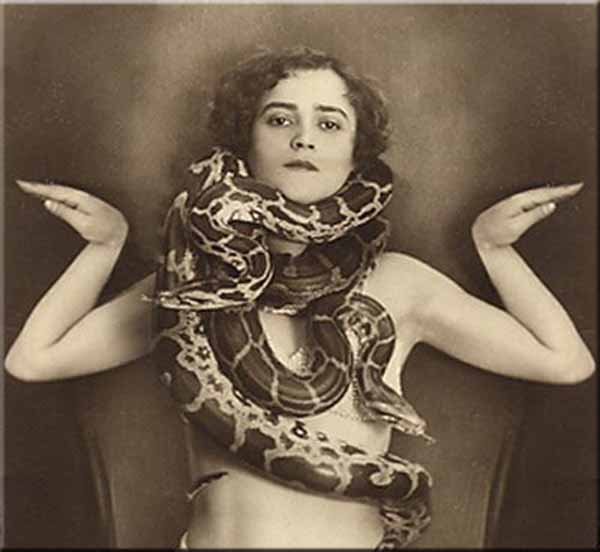
(… Snakes on a plane, snakes on a woman, snakes on a stick — snakes everywhere….)

The woman with the snake coiled around her looks particularly unhappy; I suspect this picture was not her idea…. More on men’s projection about snakes and women in the next post….

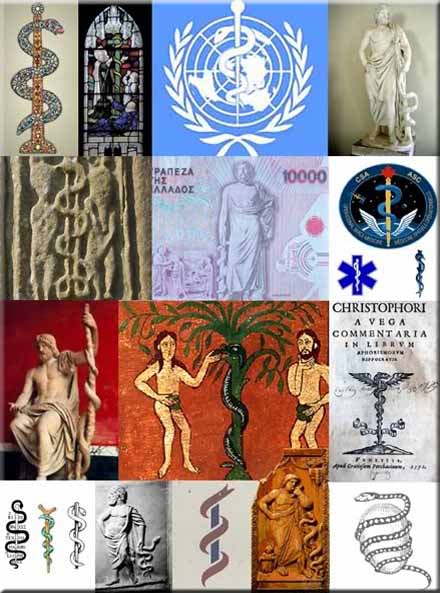
Wikipeida: Rod of Asclepius

The rod of Asclepius (sometimes also spelled Asklepios or Aesculapius), also known as the asklepian, is an ancient symbol associated with astrology, the Greek god Asclepius, and with medicine and healing.

It consists of a serpent entwined around a staff. The name of the symbol derives from its early and widespread association with Asclepius, the son of Apollo, who was a practitioner of medicine in ancient Greek mythology. His attributes, the snake and the staff, sometimes depicted separately in antiquity, are combined in this symbol…

The serpent and the staff appear to have been separate symbols that were combined at some point in the development of the Asclepian cult.

The significance of the serpent has been interpreted in many ways; sometimes the shedding of skin and renewal is emphasized as symbolizing rejuvenation, while other assessments center on the serpent as a symbol that unites and expresses the dual nature of the work of the physician, who deals with life and death, sickness and health.

The ambiguity of the serpent as a symbol, and the contradictions it is thought to represent, reflect the ambiguity of the use of drugs, which can help or harm, as reflected in the meaning of the term pharmakon, which meant “drug”, “medicine” and “poison” in ancient Greek; we know that today antidotes and vaccines are often compounded from precisely the thing that caused the poisoning or illness.

Products deriving from the bodies of snakes were known to have medicinal properties in ancient times, and in ancient Greece, at least some were aware that snake venom that might be fatal if it entered the bloodstream could often be imbibed. Snake venom appears to have been ‘prescribed’ in some cases as a form of therapy.

Source

Source of snake collage image

Snakes on a Plane (wikipedia)

Snakes on a Plane: Youtube

Synchronicity: Unus Mundus

by Stephen Parker, Ph.D (Article Selection and Commentary) on July 23, 2010

Excerpt from
Quantum Physics, Depth Psychology,and Beyond
Thomas J. McFarlane

Synchronicity is necessarily meaningful in the sense that it is a form of unconscious compensation that serves to advance the process of individuation. It is distinguished from other forms of unconscious compensation by the fact that synchronicity involves a connection between inner psychological experience and outer experiences in the world, where the connection is acausal in the sense that the inner experience cannot have been an efficient cause of the outer experience, or vice versa.

In short, synchronicity is a meaningful, acausal connection between inner and outer events. Because the phenomenon of synchronicity involves an acausal coordination of the inner and outer worlds in a meaningful way, it is not exclusively a psychological or physical phenomenon, but is “psychoid” meaning that it somehow essentially involves both psyche and matter. Thus, Jung interpreted synchronicity to imply the existence of an extremely profound level of reality prior to any distinction between psyche and matter. In other words, synchronicity phenomena represent a manifestation in consciousness of psychoid structures present in the depths of a transcendental unitary reality Jung called the unus mundus:

Since psyche and matter are contained in one and the same world, and moreover are in continuous contact with one another and ultimately rest on irrepresentable, transcendental factors, it is not only possible but fairly probable, even, that psyche and matter are two different aspects of one and the same thing.

The unus mundus is also implied by the fact that we evidently occupy one reality that contains both psyche and matter, and that these two domains of reality are not absolutely independent and isolated, but interact with each other. As Jung says,

Psyche and matter exist in one and the same world, and each partakes of the other, otherwise any reciprocal action would be impossible. If research could only advance far enough, therefore, we would arrive at an ultimate agreement between physical and psychological concepts. Source